Wait Time

In early April, I wrote about shifting the term “cold calling” to “name-end questioning.” The article was kindly mentioned in a Tom Sherrington blog post, which was a lovely experience. Tom noted that, if the goal is to be totally unambiguous through nomenclature, the pause and the crucial thinking time would be in the name itself, and suggested “Question, Pause, Name” as an alternative. This made me realise I had not always been explicit about the fact that name-end questioning doesn’t always require wait time. Tom’s suggested sequence implies that a pause is always present. But that is not always the case. When checking for understanding or checking for listening, definitely use wait time. But when asking what a student wrote on a whiteboard, or what a pair discussed in a think, pair, share, there is no need for it at all.
Wait time is there to allow time for thinking. I prefer the term “wait time” because it is an explicit reminder for the teacher to remember what to do. In practice, though, I often say “think time” or “I’ll give you a moment to think” as a student-facing phrase.
Wait time is not an easy strategy. I know this from personal experience. I like pace in my lessons, and I worked hard over the years at removing dead time. Activity transitions have always been a strength of mine, but I think a by-product of that is that wait time got forgotten. After receiving feedback on this, I started saying to myself after asking a question: wait time is important, leave some time to think. Simply saying that to myself was enough to leave the right amount of space.
Next week I will write about one of the main challenges: students calling out the answer. Another challenge is that we teachers love pace and flow. We want things to feel snappy. We have a lot to get through. Wait time feels like slowing down. It feels counterintuitive, and it is also an easy thing to forget when you have a lot to cover in a lesson. Even so, wait time combined with name-end questioning is, in my opinion, one of the most inclusive things a teacher can use in the classroom. It is telling students: your thoughts matter. All of your thoughts matter. I value your thinking.
The final hurdle is how long to give for think time. This is, for me, the hardest part, and there is no single rule. It really is question-dependent. The more you use think time, the better you get at judging the right amount.
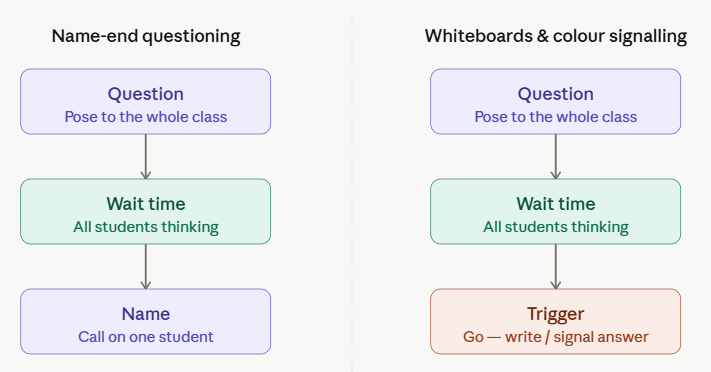
Wait time also has a place beyond questioning. When I pose a question on mini whiteboards, I follow a simple pattern: question, wait time, trigger. What’s the function of a leaf? Wait. Go. Write on your boards. I use the same pattern with colour signalling during my end-of-lesson diagnostic quizzes. Question, wait time, trigger, students answer. And this, I think, is what was missing from my earlier thinking about wait time. It is not only a questioning strategy. Anywhere a student needs time to think before responding, wait time has a role.
A useful tip I picked up from Adam Boxer on the length of wait time: if you say the name and the student is still thinking, the wait time was too short. If they immediately knew the answer, too much wait was given. Pritesh Raichura, a fantastic voice in the field and featured in the Steplab Great Teaching Unpacked documentary, talks about something called “all hands up cold calling.” I have found this to be a nice way to let students signal they have an answer and are ready. It does have one issue: once a larger proportion of students have finished thinking, most will raise their hands regardless. I did have a class with one student who was very thoughtful and slow to put his hand up, so I would often call on that student. It was a deliberate signal to the class that I value giving everyone the time to think.
For me, having an internal mantra helps. Reminding myself post-question that wait time matters is enough to leave the right amount of space. I would love to hear whether you have any strategies for making sure you leave enough wait time.