Bjork's Desirable Difficulties in Learning and Memory

I recently discovered Robert Bjork and have challenged myself to find ways of embedding this into my practice.
Most teachers know that feeling when a lesson goes smoothly. Students nod along, complete tasks with ease, and you leave thinking, "That went brilliantly." Yet weeks later, when you test their understanding, the results are disappointing. The knowledge seems to have vanished.
This disconnect between apparent success and lasting learning troubled me for years. Then I encountered Robert Bjork's concept of desirable difficulties, and it helped explain what I was observing in my classroom.
What Are Desirable Difficulties?
Bjork, a psychology professor at UCLA, introduced this concept in 1994. He distinguished between performance (what students can do right now) and learning (what they retain and can apply later). These are not the same thing, and sometimes they work against each other.
Desirable difficulties are learning conditions that make performance initially harder but create stronger, more durable learning. The key word is "desirable." Not all difficulties help learning. The challenge must trigger the right cognitive processes, and students must have enough background knowledge to succeed eventually.
This contradicts our intuition. When learning feels easy and smooth, we assume it's effective. When it feels challenging and we make mistakes, we think something's wrong. Bjork's research shows the opposite is often true.
Why Our Intuitions Mislead Us
I've watched countless students choose the easy revision methods. They reread notes, highlight text, and feel confident because the material seems familiar. This creates what Bjork calls "illusions of knowing." The information feels accessible in the moment but hasn't been truly learnt.
Meanwhile, students avoid the harder work of testing themselves or mixing up topics because it feels uncomfortable. They struggle, make errors, and conclude the method isn't working. Yet this struggle is exactly what builds lasting knowledge.
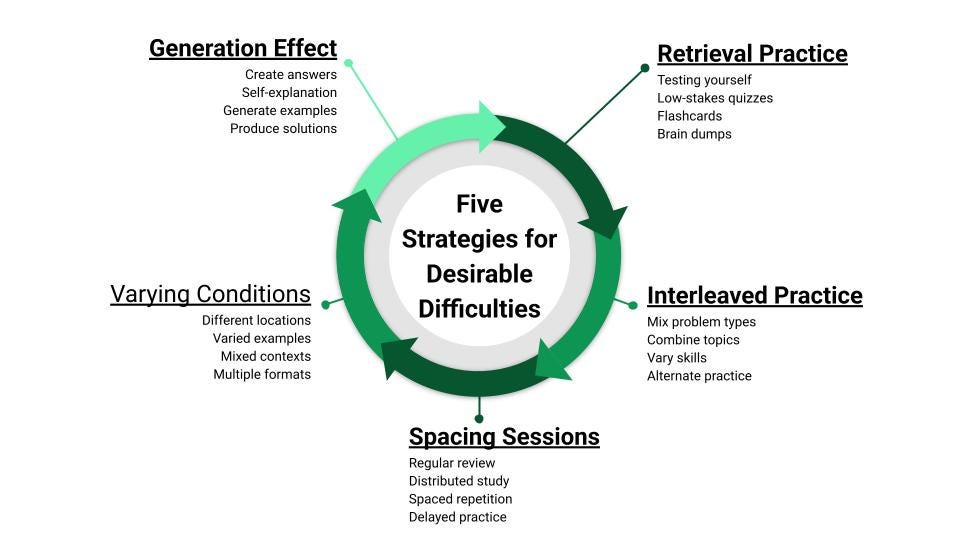
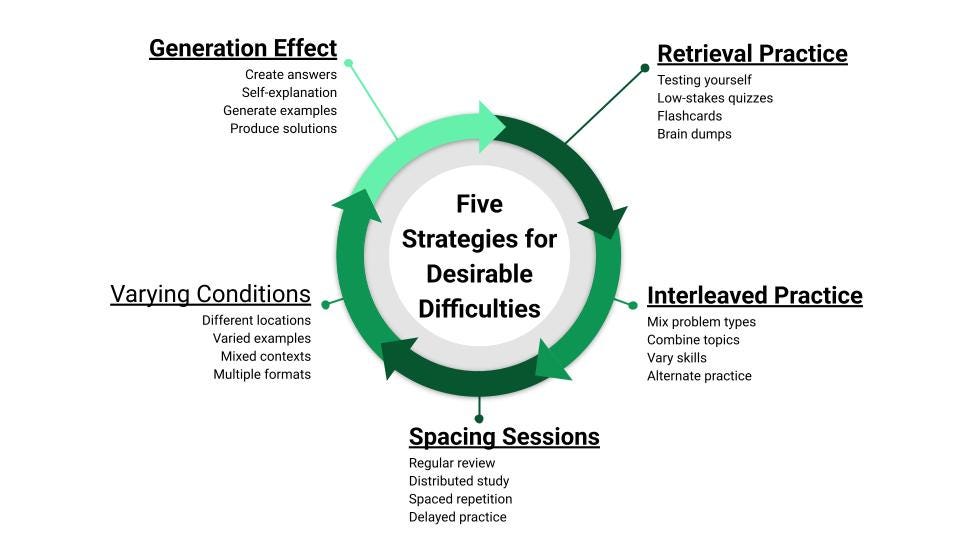
Five Practical Strategies for Embedding Desirable Difficulties
Through my classroom experience and Bjork's research, I've identified five strategies that create productive challenges for students:
1. Retrieval Practice
This means getting students to actively recall information rather than simply recognising it. In my maths lessons, instead of showing worked examples, I ask students to attempt problems first. Even when they struggle or get answers wrong, this initial attempt makes subsequent learning more effective.
I use low-stakes quizzes regularly, not for marks but for learning. Students might groan, but the results speak for themselves. Topics we've tested stick much better than those we've simply covered.
Practical applications:
Begin lessons by asking students to recall previous content before teaching new material
Use "brain dumps" where students write everything they remember about a topic
Create flashcards for key concepts and use them regularly
Ask students to explain concepts to each other
2. Interleaved Practice
Rather than practising one skill at a time (blocked practice), interleaving mixes different skills or concepts within the same session. In my English lessons, instead of spending a whole week on metaphors followed by a week on similes, I mix various literary devices within each lesson.
This approach feels less organised and students initially perform worse. However, they develop better discrimination skills and retain knowledge longer because they must constantly decide which approach to use.
Practical applications:
Mix different problem types in mathematics rather than grouping them by method
Combine various writing techniques in single assignments
Alternate between different scientific concepts during revision sessions
Present historical events from different periods within the same lesson
3. Spacing Study Sessions
The spacing effect is one of the most robust findings in learning research. Information learned over distributed sessions is retained far better than information crammed in single sessions.
I now deliberately revisit topics throughout the term rather than teaching them once and moving on. This requires careful planning but dramatically improves retention. Students might complain about "doing this again," but that repetition across time is precisely what builds lasting knowledge.
Practical applications:
Build regular review into lesson plans
Create spiralling curricula that revisit concepts with increasing complexity
Use spaced repetition systems for vocabulary or key facts
Schedule mock exams throughout the year rather than just before finals
4. Varying Conditions of Learning
When learning occurs in too predictable a context, students struggle to apply knowledge in new situations. I deliberately vary examples, settings, and approaches to the same concept.
For instance, when teaching fractions, I don't just use pizza examples. I use measuring cups, money, time, and abstract representations. This variation makes initial learning harder but improves transfer to new contexts.
Practical applications:
Use diverse examples when introducing concepts
Study the same material in different physical locations
Vary the format of practice questions
Present information through multiple modalities (visual, auditory, kinaesthetic)
5. Generation Effect
Students learn better when they generate answers themselves rather than being given them directly. This doesn't mean leaving them to struggle without support, but rather providing scaffolding that helps them construct understanding.
In my science lessons, instead of explaining why certain reactions occur, I provide clues and let students work towards explanations. The effort of generation, even with support, creates stronger memories than passive reception of information.
Practical applications:
Use guided discovery rather than direct instruction when possible
Encourage students to create their own examples
Ask students to predict outcomes before demonstrations
Have students generate questions about the material
Implementation Challenges
Implementing desirable difficulties requires overcoming resistance from multiple sources. Students often prefer easier methods that feel more successful in the short term. Parents might worry when homework becomes more challenging. Even colleagues might question approaches that make learning visibly harder.
I've learned to explain the rationale upfront. When students understand why they're being challenged in specific ways, they're more likely to persist through difficulties. I also track long-term retention to demonstrate effectiveness, not just immediate performance.
The key is ensuring difficulties remain desirable. If students lack prerequisite knowledge or the challenge becomes overwhelming, difficulties stop being productive. Careful scaffolding and ongoing assessment help maintain the right level of challenge.
Moving Forward
Bjork's research has influenced how I approach teaching and learning. I now view student struggles and mistakes differently. Rather than smoothing away all difficulties, I deliberately introduce productive challenges that build lasting understanding.
This doesn't mean making learning unnecessarily hard or abandoning support structures. It means recognising that some difficulties serve learning, even when they feel uncomfortable in the moment.
For educators wanting to implement these ideas, start small. Choose one strategy and experiment with it. Monitor both immediate performance and longer-term retention. Adjust based on what you observe, but don't abandon approaches simply because they initially feel more difficult.
The goal isn't to make learning hard for its own sake, but to make it durable. Bjork's desirable difficulties offer a research-backed path towards that goal, even when it challenges our intuitions about effective teaching and learning.