Adaptive Teaching: Maintaining High Expectations While Meeting Individual Needs

I observed in a science class differentiation used in such a way that these primary 3 students were given a barrier from the teacher. I never interrupt observations but this lesson was an exception as I witnessed a clear routine where five or six students were moved into one group and given a worksheet that was dumbed down so that there was zero learning taking place. In the teacher's mind the differentiation box was being checked but these students knew that their expected learning outcomes were far below the rest of the students. Witnessing this was a wake up call for me as I realised I needed to find a way to mentor my teachers in a way that creates a more sustainable way of meeting students' wide variety of needs.
Adaptive teaching is a term that has risen in popularity for good reason as it shifts the aspect of what should be changed to meet specific needs from the task to the input. When we meet the needs of our students we must always have high expectations. That is the essential aspect of what the teacher got wrong—they differentiate the expectations signalling to the student "I don't believe you can access this content, so don't try". I want to provide some strategies for adapting your teaching while maintaining high expectations for all.
Know Your Learners Deeply
The first strategy focuses on getting to know your students. Following up on students and tracking them is an essential aspect of being an adaptive teacher. Use the EAL interview model: In the first week of school, we have speaking pre-assessments to gauge the levels of students. I have found that this is an excellent way of quickly getting to know your students. Finding out what students are passionate about is the first step in knowing them.
Understanding your learners involves proactively identifying potential barriers to learning. Research emphasises the importance of understanding pupils' prior knowledge, recognising specific needs of SEND or EAL pupils, and building a comprehensive picture of each learner's starting points. This deep knowledge informs both pre-lesson planning and enables in-the-moment adaptations during teaching.
Creating student profiles or "pupil passports" can help teachers pre-empt potential difficulties and plan appropriate responses. These profiles should go beyond academic data to include strengths, interests, and areas for development. Regularly updating these profiles ensures that your understanding of each student evolves alongside their progress and changing needs.
Adapt the Scaffolding, Not the Content
Instead of adapting the content, change the scaffolding. Some students may not need scaffolding whereas others may need a lot. This is the most important part of the adaptation.
The concept of scaffolding in adaptive teaching refers to temporary supports that gradually fade as learners develop independence. These might include word banks, visual supports, language frames, or adult guidance, all designed to help pupils work towards the same objective as their peers. The critical distinction from traditional differentiation is that scaffolding maintains the same high expectations while providing different pathways to success.
Model what a good example looks like, perhaps using work from a previous year. Research shows that sharing WAGOLLs (What A Good One Looks Like) provides a visual example of expectations and supports students in confidently approaching tasks. Live modelling, where you verbalise your thought process when solving a problem or completing a task, provides concrete examples and can significantly reduce cognitive load for students.
The "I do, we do, you do" model exemplifies the scaffolding approach, moving from teacher-led instruction to guided practice and finally to independent learning. This structured progression ensures that all students can access challenging content while developing autonomy in their learning.
The Adaptive Teaching Cycle
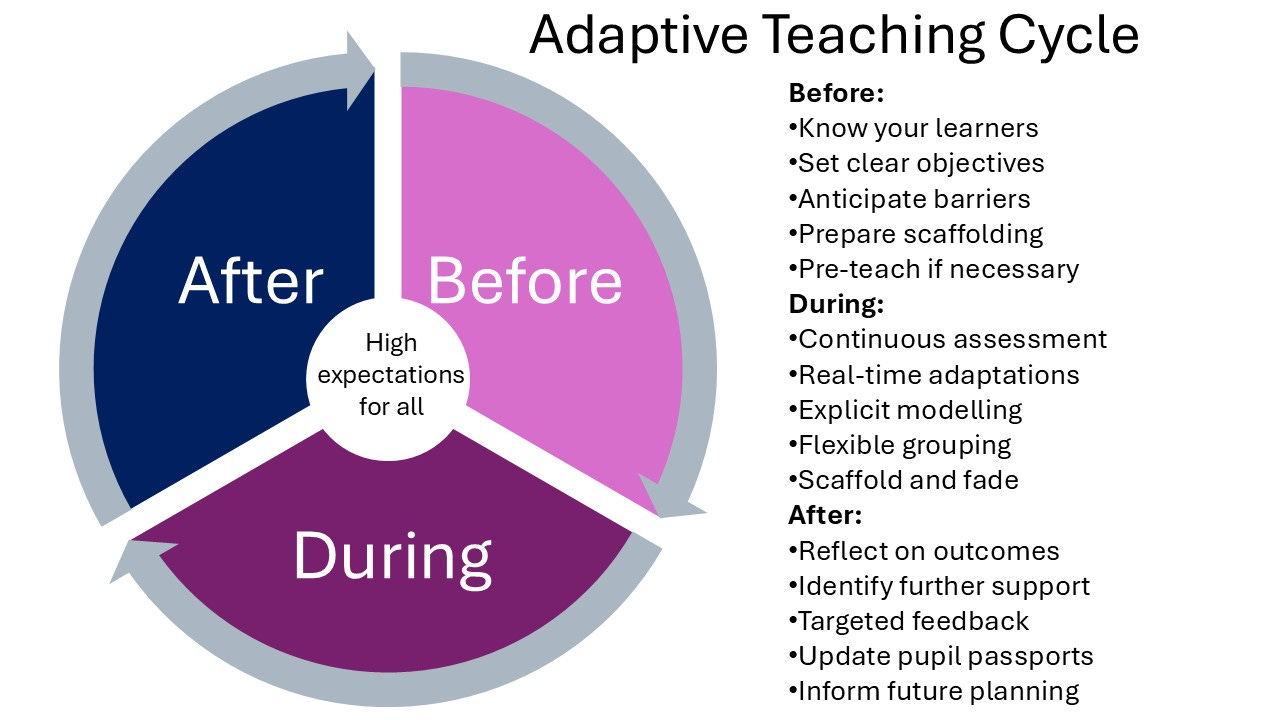
The adaptive teaching cycle of before, during, and after is a good framework to think about. This cyclical process emphasises continuous assessment and adjustment to meet diverse learning needs.
Before the Lesson
Effective planning begins with anticipating variability among learners. Knowing your students well allows you to connect new content with their existing knowledge and identify who might benefit from pre-teaching certain concepts or vocabulary. Mind maps can be particularly effective for pre-teaching and can be built upon throughout a unit of work.
Setting clear, skill-based learning objectives rather than task-driven ones is crucial. Break down tasks into manageable steps for students to follow, ensuring all learners understand what successful learning looks like. This preparation involves reviewing and adapting existing materials to pre-empt potential difficulties based on individual pupils' needs.
Consider flexible grouping strategies that will allow you to provide targeted support during the lesson. Unlike fixed ability groups, these temporary arrangements ensure all pupils have access to a rich curriculum with appropriately high expectations.
During the Lesson
Continuous formative assessment forms the backbone of adaptive teaching during lessons. Using techniques like diagnostic questions, hinge questions, mini-whiteboards, and think-pair-share provides immediate insight into student understanding. The goal is to know what students know during the lesson, not after.
Research indicates that making in-the-moment adaptations benefits multiple learners. These adjustments might include modifying explanations, providing additional examples, using analogies, increasing or decreasing scaffolding, reading texts aloud, projecting diagrams, or utilising peer support. The key is responsiveness—if something isn't working, change it immediately.
Encouraging student feedback through techniques like "start-stop-continue" or using coloured cards to signal understanding helps inform these immediate adjustments. This two-way communication creates a classroom culture where adaptation is normalised and expected.
After the Lesson
Reflection is a critical component of the adaptive teaching cycle. After each lesson, consider whether all learners achieved the required level of understanding and identify those needing further support or greater challenge in subsequent lessons.
Use assessment data strategically to inform future planning. This might involve re-teaching content that wasn't fully grasped or pre-teaching topics the class is likely to struggle with. Keeping a teacher journal to track student progress, record new insights, and note areas requiring additional attention can support this reflective practice.
Collaboration with colleagues enhances adaptive teaching. Sharing successful strategies and discussing individual student needs creates a professional learning community focused on meeting diverse learner requirements. Regular updating of pupil passports with new information about effective adaptations ensures this knowledge is captured and utilised.
Common Pitfalls to Avoid
The science class scenario I described represents a common misunderstanding of differentiation. Educational research highlights several other pitfalls in attempts to adapt teaching:
Lowering expectations through creating 'easier' tasks rather than providing appropriate support fundamentally undermines the principle that all students should access a rich curriculum. Over-scaffolding can be equally problematic, providing so much support that students aren't challenged to develop independence.
Static groupings, once common in differentiated classrooms, can create stigma and limit progress. Adaptive teaching recognises that student needs fluctuate across subjects, topics, and even within different aspects of the same lesson. Flexible grouping allows for targeted support without creating fixed perceptions of ability.
Many teachers focus exclusively on task differentiation, creating multiple versions of worksheets or activities. Adaptive teaching shifts emphasis to considering different ways to teach, recognising that if pupils can't learn the way we teach, we must teach the way they learn.
The Impact of Effective Adaptive Teaching
When adaptive teaching is implemented well, the classroom atmosphere transforms. Students develop greater agency in their learning, metacognitive skills improve, and the stigma associated with receiving support diminishes. Most importantly, all students experience appropriate challenge and success.
Teachers who master adaptive teaching report greater job satisfaction as they see all their students making progress. Rather than feeling overwhelmed by diverse needs, they develop a toolkit of strategies that become second nature.
Conclusion
Adaptive teaching isn't about creating multiple lesson plans or lowering expectations for certain students. It's about developing responsive approaches that maintain high expectations while acknowledging and addressing the barriers that different students face. By focusing on adapting our teaching rather than diluting content, we can create classrooms where every student is appropriately challenged and supported to achieve their potential.
The most powerful message we can send our students is: "This is challenging, but I believe you can do it, and I'll help you get there." That belief, coupled with skilled adaptive teaching, can transform learning outcomes for all students.